Spring power in drug delivery - considerations in harnessing the potentials of springs
Spring-driven mechanisms have become indispensable in many modern drug delivery devices. These compact energy sources are at the heart of products ranging from autoinjectors and spring powered pens, which aim to reduce the burden of self-injection, patch and large volume injectors, enabling more ‘at home’ drug delivery, through to breath-actuated inhalers, helping patients’ synchronise their inhalation with device actuation, so aiding compliance.
By storing and releasing mechanical energy, springs automate key functions, reducing user effort and improving the overall experience. They also offer the significant appeal of a consistent operating force profile that is independent of user capability, helping to provide more reliable and comfortable delivery performance. However, integrating springs into drug delivery devices presents a range of complex engineering challenges, demanding careful consideration of materials, manufacturing methods, user interaction, and safety.
In this article, we explore eight challenges designers face when incorporating springs into drug delivery devices and outline practical strategies to overcome them.

1. Predicting spring performance
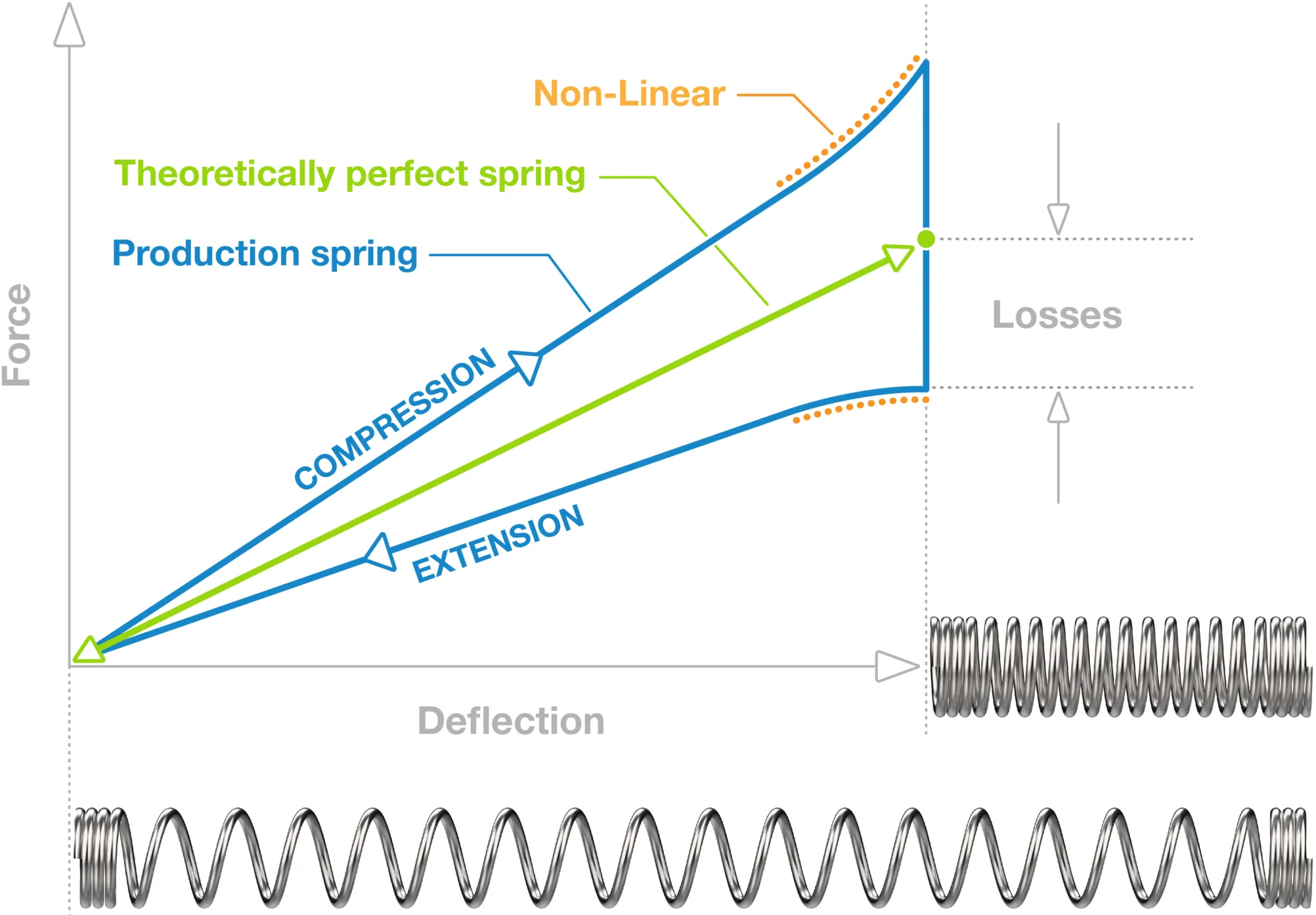
One of the first and most critical hurdles in spring design is accurately predicting the force a spring will deliver. In principle, it’s simple; textbook formulae use parameters such as wire diameter, spring diameter, deflection, number of coils, and material properties to estimate output force. However, these calculations assume ideal spring behaviour, zero losses and consistent material properties.
In reality, the picture is significantly more nuanced. Spring performance can be impacted by many factors; friction between coils, losses at contact interfaces and inherent instabilities leading to spring buckling, all of which undermine the accuracy of the basic calculations. Even minor inconsistencies in wire diameter or batch-to-batch variability in material properties can significantly affect spring performance. Compounding the issue, wire suppliers seldom provide shear stress limits (a key input for compression spring design), so engineers often have to rely on tensile stress based approximations. This leads to springs that may be overdesigned, adding unnecessary size and mass, or underperforming components that risk premature failure.
Material selection is another pivotal factor. It’s not just the spring wire itself that matters, but also any coating, plating or lubricant, and the materials of mating components. System-wide friction plays a major role in determining effective output force. That’s why understanding how a spring behaves within the full assembly, and across its entire range of motion, is vital. Only by designing guiding features and constraints with the whole system in mind can engineers achieve the precision and reliability that today’s drug delivery devices demand.
2. Spring design for compact, high-energy devices
Medical devices often require compact, high-performance springs, requiring engineers to push closer to the limits of material and geometry to maximise energy storage in the smallest possible space. But as deflection increases, where the most energy is stored, spring behaviour becomes highly non-linear and far harder to predict. Modelling performance accurately at these extremes is a significant challenge, requiring experience and an understanding of the important factors.
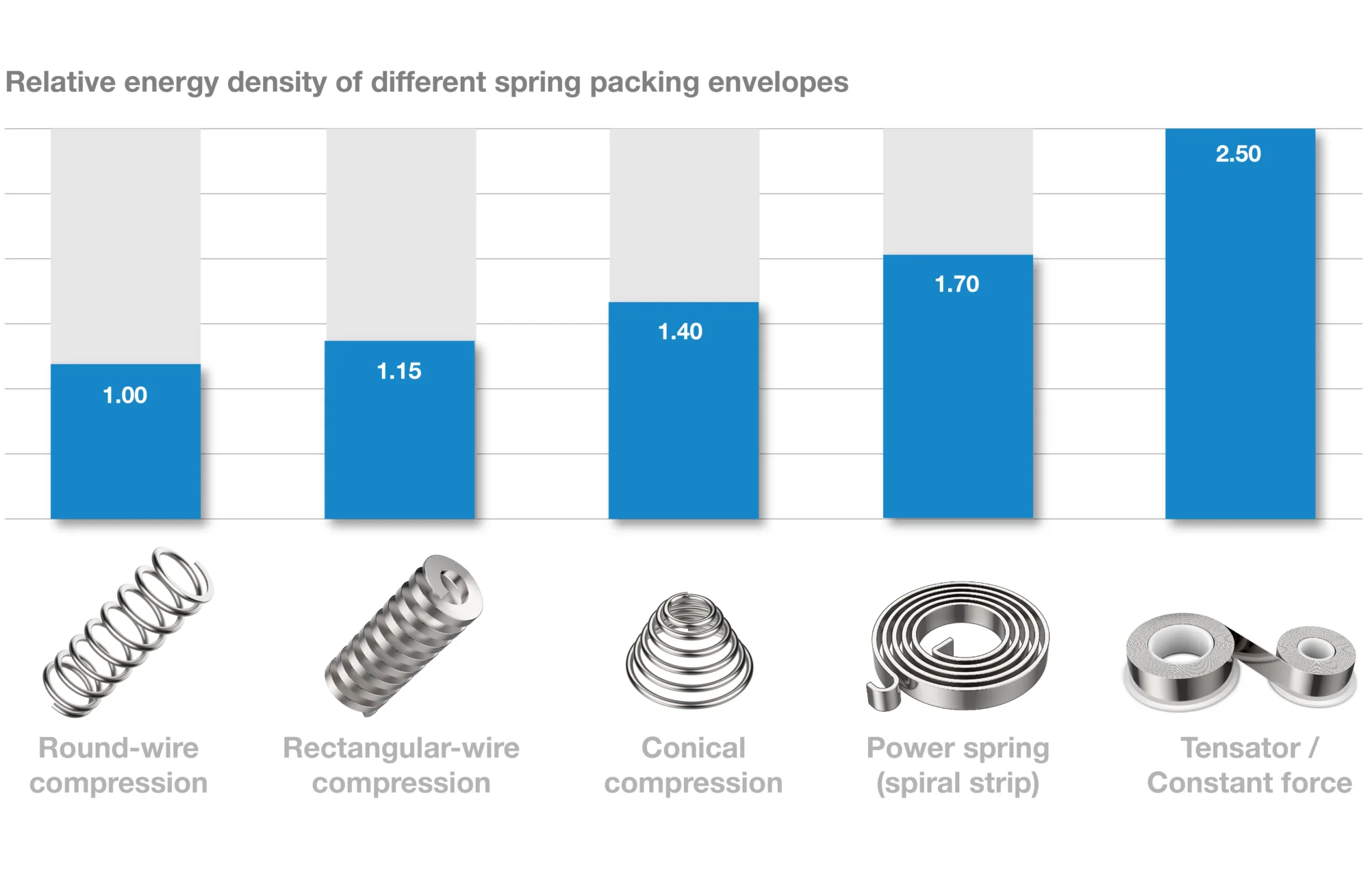
Conventional compression and tension springs remain popular due to their simplicity and cost-effectiveness. However, they are not always the most space-efficient choice. When maximum energy density is essential, specialised alternatives like conical, power, or tensator springs can store significantly more energy within a smaller footprint. Similarly, springs made from square or rectangular wire can deliver higher energy output by pushing more material closer to its yield limit, reducing size without sacrificing performance.
While high-density spring types offer powerful advantages, they come with increased manufacturing complexity and cost. In some cases, specific force responses, such as constant or non-linear output, may justify the use of specialised designs. However, switching from standard round-wire springs solely for energy density gains must be carefully evaluated, as it can drive up costs without delivering proportional system-level benefits. Ultimately, the decision must balance performance needs, spatial constraints, and cost-efficiency.
3. Maximising output force
To boost energy density without the steep cost of specialised geometries, engineers may turn to process-level enhancements like heat treatment and spring setting. While these methods offer practical benefits, they introduce additional layers of complexity, particularly when it comes to accurately predicting output force.
Post-forming heat treatment is typically used to relieve residual tensile stresses created during the forming process. When applied correctly, it can raise the elastic limit of the material and stabilise spring dimensions. However, process variations can lead to uneven material properties, not just across production batches but even among individual coils within the same spring. This inconsistency can, if operating springs near their limit, result in premature yielding of some coils, disrupting performance and reducing reliability.
Spring setting, or pre-setting, is another widely used technique. Intentionally over-deflecting the spring induces controlled material yield, redistributing internal stresses and stabilising dimensions. This can improve both consistency and energy storage, particularly over repeated cycles. Yet this method also complicates matters for the designer. The degree of yield introduced, and its effect on force output, can be difficult to predict, adding further uncertainty to theoretical models.
Ultimately, while heat treatment and spring setting can enhance performance and cost-efficiency, their application must be carefully controlled to avoid introducing additional force variation that undermines the very benefits they aim to provide.
Heat treatment and spring setting can enhance performance but add complexity to accurately predicting spring output force
4. Limits of Theory and the Role of Prototypes
As discussed above, a theoretical approach to designing with springs is complex and has some inherent limitations and uncertainties. An empirical approach – manufacturing and testing prototype spring samples to fine-tune performance, relying solely on trial and error, can be costly and time-consuming. We use a hybrid strategy that combines limited physical testing with theoretical insights for an informed, evidence-based approach that delivers robust solutions.
This hybrid strategy also brings in early engagement with spring manufacturers. Clear communication of critical design requirements to manufacturing partners is essential. When manufacturers have flexibility to adjust parameters such as coil pitch or the number of active coils, they can better contribute to optimise the design to meet key performance criteria.
We use a hybrid strategy that combines limited physical testing with theoretical insights for an informed, evidence-based approach that delivers robust solutions
5. Manufacture and assembly challenges
Designing springs for high performance is only half the challenge, ensuring they can be manufactured and assembled efficiently is also critical to keeping production costs in check. Factors like spring index (the ratio of coil diameter to wire diameter), standard wire availability, end configurations, and coil pitch variations all directly influence manufacturability. Neglecting these in the design phase can lead to higher costs, reduced supplier options, and unpredictable performance across production runs.
A spring that adheres to sound manufacturing principles not only reduces part cost but also enables broader sourcing flexibility, improves consistency across batches, and minimises development effort. Thoughtful design decisions can open doors to scalable, repeatable manufacturing, which is key for high-volume medical devices.
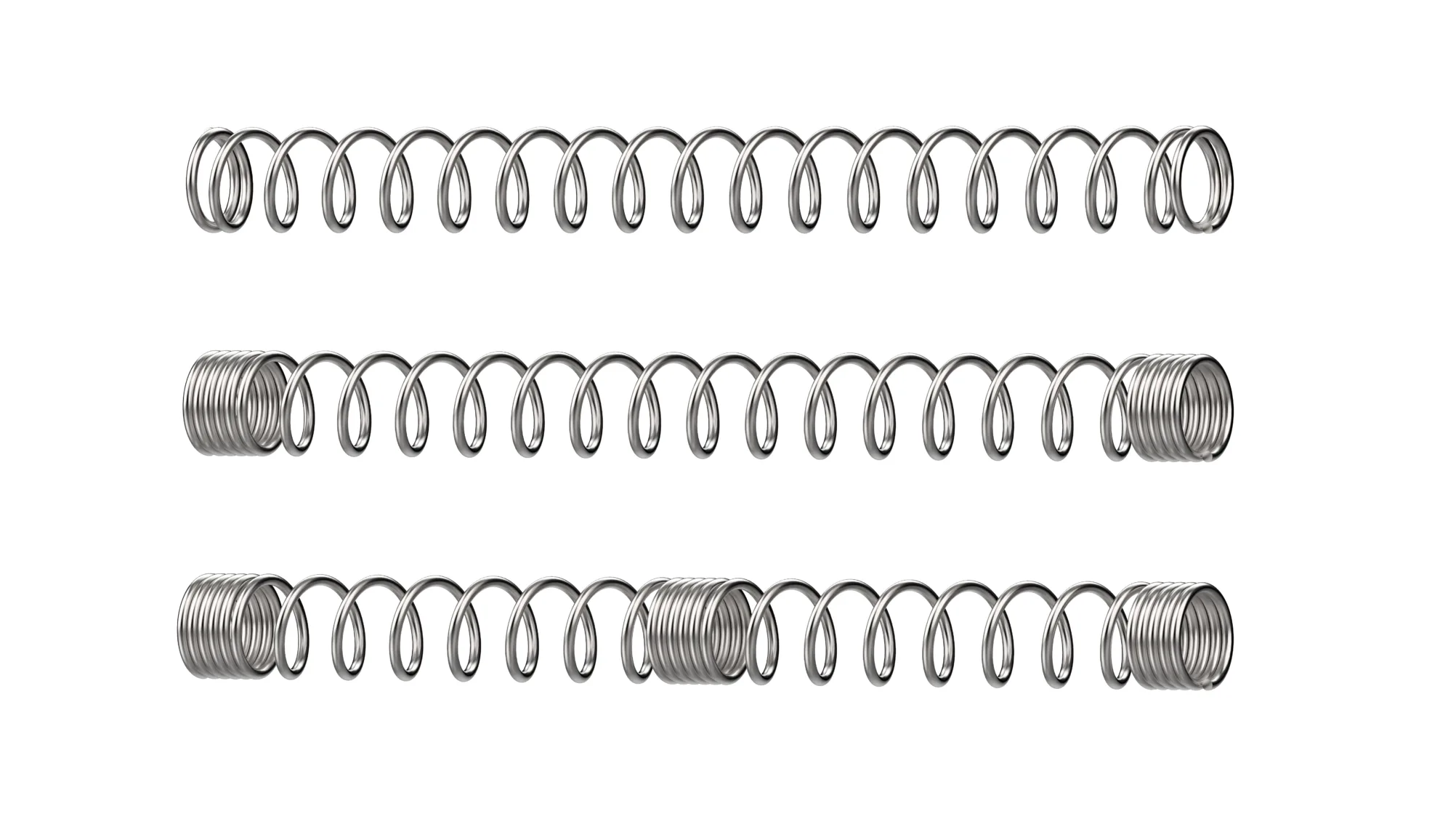
Assembly introduces its own set of challenges. Due to their flexible nature, open coil springs are prone to tangling and buckling unless properly managed. While adding closed or “dead” coils at the ends or at intervals can help prevent tangling, these design changes increase material use and add complexity to production. The benefits in handling and assembly must be carefully weighed against the impact on spring size, weight, and energy density.
Dead coils also consume valuable space and material, often conflicting with performance targets. That’s why it’s essential to integrate assembly considerations into the core of device design. Clever component design can ease spring handling by incorporating guiding features or locating elements directly into the device, reducing reliance on complex grippers or nests and boosting assembly reliability.
6. Managing the stress of long-term storage
Once assembled, spring-powered medical devices often face long periods of storage before they are ever used. During this time, springs, especially those held in a compressed state, can gradually relax, leading to a drop in force output. The situation becomes even more challenging when springs are preloaded into polymer housings. Constant stress can cause the surrounding polymers to creep, and this deformation is highly sensitive to storage conditions.
Polymer creep accelerates with higher temperature, and because its mechanical response is nonlinear, relying solely on standard accelerated-aging protocols can paint an inaccurate picture of in-field behaviour. Worst-case testing must therefore balance realistic timeframes with conservative temperature profiles to avoid under or over estimating endurance. Without appropriate controls, a spring held for weeks or months can lose energy before the drug product is ever loaded and well before the device is actuated.

7. Safety risks: Unintended actuation and force control
Safety is non-negotiable for drug delivery devices. A compressed spring can store considerable energy, which can be released in an instant if not properly restrained. Accidental activation during transport, storage, handling, or impact may pose a serious safety risk. Mitigating these risks begins with robust trigger mechanism design, often incorporating interlocks and fail-safe features. Force and torque balances must be thoroughly modelled and proven across the full spectrum of system tolerances to ensure reliable containment under all conditions.
In multi-dose devices, the energy stored in the spring may be able to deliver far more than a single set dose, so the energy release must be precisely controlled. Reliable dose-stop features are essential to prevent overdosing, and they must withstand repeated stresses without failure.
Upon activation, the rapid discharge of energy can generate high-impact forces. This may produce loud noises that startle patients or compromise discretion during use and can even damage sensitive components like glass syringes. In some cases, the internal impact forces exceed those encountered during drop testing, making energy absorption, damping, and impact tolerance critical elements of the design.
Ultimately, maintaining safety throughout the device lifecycle demands a holistic approach – one that anticipates failure modes, incorporates layered safeguards, and ensures confidence from shelf to final actuation.

8. Environmental impact
As sustainability draws greater attention, environmental considerations in spring-powered devices are becoming increasingly important. The spring is often the key component that dictates the overall format, size and complexity of a device; if the specification of the spring is wrong, then this can propagate through the entire development causing widespread consequences. For example, an over specified spring may lead to a heavier and bulkier device, not only due to the size and weight of the spring itself, but also from the more robust retention and support structures that are required to restrain the stronger spring during shelf-life and operation. This can lead in turn to greater device complexity and higher actuation forces, potentially resulting in compromised usability as well as increased environmental burdens. Component production and transportation costs may also increase as parts become larger and more complex. Production waste, storage and distribution overheads may also rise. There are further sustainability impacts of poor spring design beyond the point of use; for example, medical waste disposal volumes may be higher and, as recycling becomes more widespread, the fact many spring-powered devices contain appreciable stored energy in the spring after use may also create challenges. Whilst some residual spring energy is typically necessary to guarantee all the medication is reliably expelled during use, it does represent waste and may also pose a hazard during disassembly for recycling. Simplifying the disassembly process, making it easier to separate materials, and incorporating mechanisms to safely dissipate stored energy at the end of device life are other ways that can aid recyclability and help to reduce waste.
A spring may be incorrectly specified for several reasons, sometimes because the requirements have been poorly defined, occasionally unnecessary factors of safety will have been added based on flawed assumptions or potentially because some of the complexities of spring-based systems have not been properly understood. Careful review of the device requirements that underpin the spring design specification and an understanding of the important design considerations can help to mitigate these risks and ensure the device is built on an efficient and robust set of requirements. Choices that may appear to be relatively minor during early design phases can multiply up to have both significant environmental and development cost impacts when scaled across millions of units.
Choices that may appear to be relatively minor during early design phases can multiply up to have both significant environmental and development cost impacts when scaled across millions of units
Conclusion: Harnessing the power of springs in drug delivery
Spring-powered drug delivery systems offer many advantages: automated operation, compact design, and reliable force delivery. But unlocking these benefits demands a deep understanding of spring mechanics, material science, and system-level engineering using an evidence-based approach that combines theory with practical testing.
By specifying the right spring for the application, anticipating real-world stresses, embedding safety, and designing with sustainability in mind, designers can maximise the benefits of a deceptively simple component. The result? Devices that are not only more effective and user-friendly, but also safer and sustainable, all while improving outcomes for patients.
Article by Will Marsh, Senior Sector Manager, Medical and Scientific